COPYWRITING TEARDOWN
Your LinkedIn ads got someone’s attention. What happens next?
Imagine a company clicks one of your LinkedIn ads. Later that week, someone from the same account visits your pricing page. Marketing adds the company to a spreadsheet and sends it to sales.
Now sales has a company name. They still have to figure out whether it’s worth a conversation, who to contact, and what to say.
That’s the problem I’d build the post around. In this anonymized copywriting exercise, the original had a useful idea buried near the end. Marketing and sales need to agree on what happens after someone shows interest.
Before · The original LinkedIn post
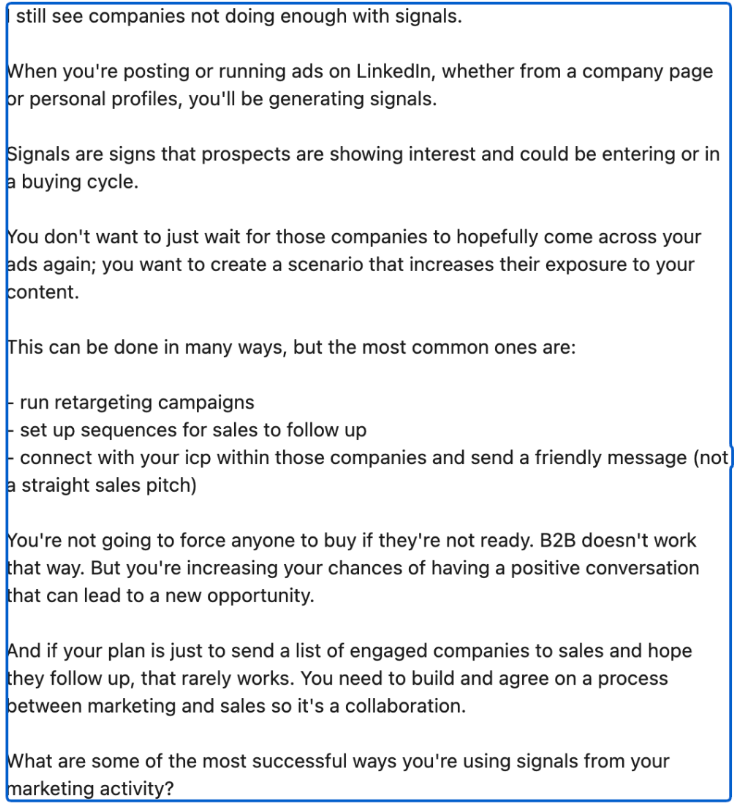
LinkedIn posts and ads can show you which companies might be interested in what you sell. Use those signals to decide who should see more ads, who sales should follow up with, and who you might connect with on LinkedIn. Marketing and sales should agree on how to follow up.
After · The rewritten LinkedIn post
Your LinkedIn ads got a buyer’s attention. What did sales get?
If the answer is “a spreadsheet of engaged companies,” they still have to figure out who’s worth contacting and why.
Here’s how I’d sort that list.
One ad click. Keep the company in your retargeting audience. A click gives you very little to go on.
Repeat visits to a buying page from a company you’d want as a client. Ask sales to review the account. Give them the page that drew interest and a relevant problem they can open a conversation around.
A demo request. Give it to a named owner so someone can reply promptly.
If you’re doing outreach, use the signal to pick a useful topic. “We saw you on our pricing page” is a line I’d leave out.
Before your next campaign, pick one signal with your sales team. Agree on what action it earns and who takes it. Then see how often that action starts a conversation worth having.
What I changed and why
- I opened with the sales handoff. A spreadsheet is something the reader can picture. It gives the post a specific problem to solve.
- I gave each tactic a reason to be there. Retargeting, account review, and a direct reply fit different levels of interest. Showing where I’d draw those lines gives a potential client a feel for how I’d make decisions on their campaign.
- I ended with a decision the reader can make this week. Pick one signal, agree on the next step, and name the person who owns it. That makes the advice usable even for a small team.
Try this on your last educational LinkedIn post. Could a potential client tell what you’d do differently in their situation? If the answer is fuzzy, add one example that shows how you’d make the call.
This is how I approach LinkedIn ghostwriting and B2B copywriting at Ruvance. I look for the decision you make differently from your peers and write the post around an example that shows it.